
Climate Anxiety: From Doom to Connection
Sustainability Matters a show, from CUNY TV, invited Voz to participate in this month’s show dedicated to mental health. Sustainability Matters is hosted by Tria Case -the University Executive Director of Sustainability and Energy Conservation. This studio show comes monthly where Tria interviews leading experts to explores climate change and its impact, renewable energies and sustainable practices in New York. There is a segment at the end of the show where Caera Beigtol, producer and Climate Communicator, provides recommendations to the audience on how to apply the learnings the episode. Tria and Caera joined Gisela to meditate with sound vibration, aka Voz practice, on a sacred circle at Central Park.
To understand mental health from the perspective of what Voz offers it is important to reflect on the following. What we often call anxiety—especially in the face of the climate crisis—is not simply something to fix or silence. It is information. It is a signal asking us to pay attention. When we listen closely, anxiety reveals where we are overwhelmed, disconnected, or trying to solve something with only one tool: the mind.
The mind is powerful, but it is not enough on its own. Like an overused muscle, it can exhaust itself when it cannot find resolution. This is when anxiety, depression, or a sense of doom can take over. What we need is not more thinking—we need an embodied outlet, one that includes pleasure, expression, and presence.
This is where Voz comes in.
Rooted in my training in Voz Esencial, a chanting meditation I learned from my teacher Virginia Gascón, this practice invites us out of the mind and into the body through the vibration of our own voice. I came to it during a time of deep anxiety, panic attacks, and physical pain. What I discovered was not escape, but a way to face crisis differently—as a teacher asking for change and guiding us through.
When we vibrate with our voice, we stimulate the vagus nerve, activating the parasympathetic nervous system—the body’s “rest and digest” state. This reduces stress, lowers cortisol, and creates a sense of safety and calm. But beyond regulation, Voz offers something more: relationship as a tool.
Through sound, breath, and attention, we attune to our surroundings —first by listening to ourselves, to each other, and to the land, then by going beyond that first layer. Everything vibrates. From atoms to ecosystems, we are part of a living field of energy in constant motion. When we quiet the mind and attune to this subtle vibration, we begin to feel our place within it.
When we listen to the ground, we become aware of the life beneath our feet. When we listen to the wind and all that it carries, we begin to notice how far seeds have traveled, how birds gather and move above us. We sense how trees and plants care for us—offering oxygen, shade, herbs, and flowers that meet us with scent and presence. This awareness that we are part of a system enhances. We begin to feel that the land is not separate from us, and rather, we belong to the land. This land loves us.
With practice, our inner vibration meets the vibration of the world around us. We enter into a conversation—not through words, but through resonance. Sometimes it is hard to describe these encounters because they go beyond words.
In group practice, something else happens. Our voices begin to move together, like a flock of birds—an example of what biology calls emergence, where the whole becomes more than the sum of its parts. Without forcing it, we align. It is another confirmation that we are part of a system.
As we deepen this relationship with the land, with each other, and with ourselves, the vibrational frequency of our experience shifts. What once felt like doom begins to open into connection and possibility—not as an idea, but as something felt in the body.
Voz does not remove the reality of the climate crisis. It changes how we relate to it.
From fear to presence.
From isolation to connection.
From paralysis to vibration.
What to Expect in a Voz Practice
Voz is a voice-led meditation that usually lasts between 90 and 100 minutes. Over time, we’ve developed a structure—a container—that helps guide us into a calm, meditative state through the body and the voice. For this session, we’ll experience a shorter version, about 20–30 minutes.
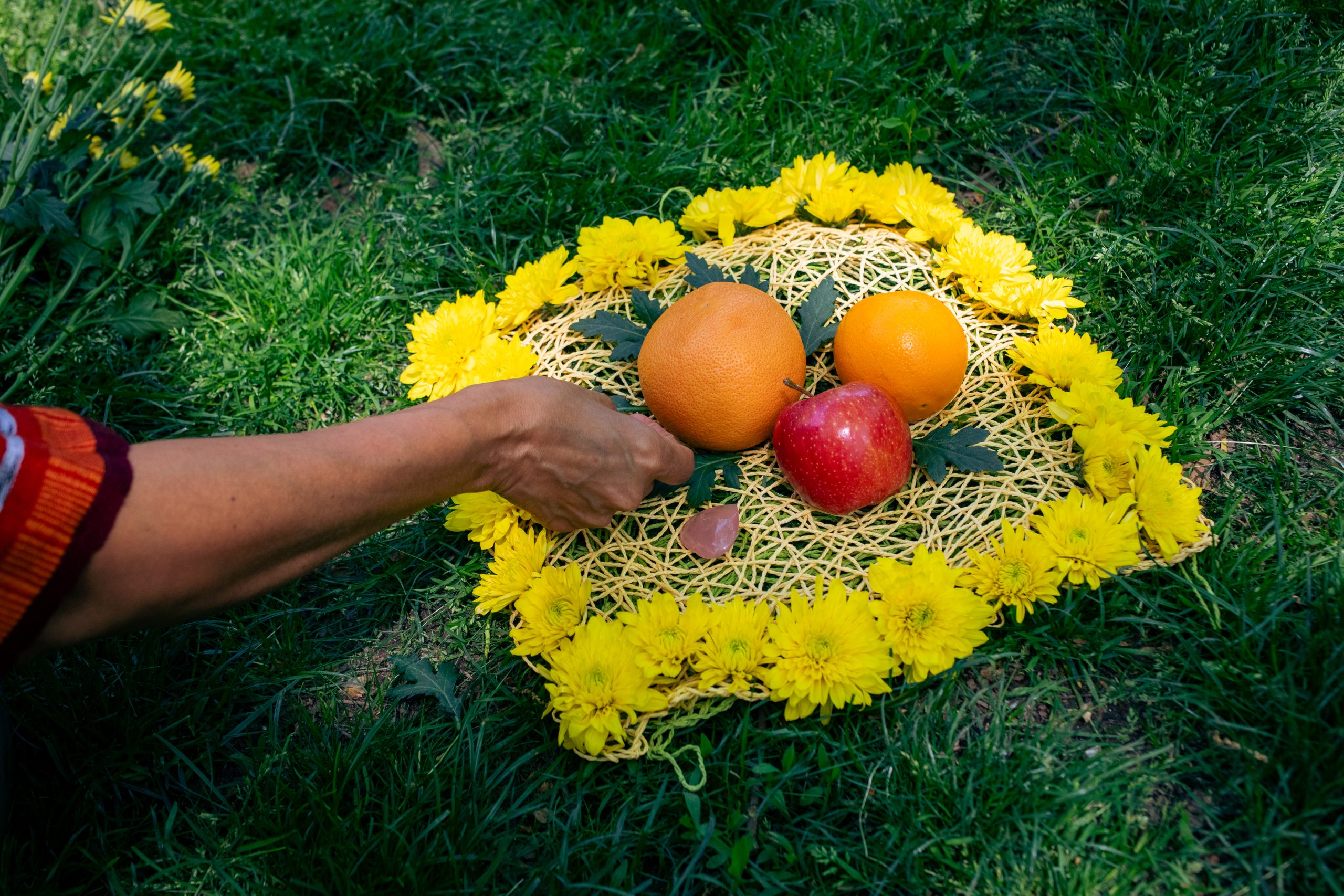
We’ll sit together in a sacred circle, oriented to the cardinal directions. The space will be prepared with yoga blankets and blocks so you can find a comfortable position. In the center, there will be an altar with flowers, and you’re welcome to place a personal object there if you’d like to carry its energy with you afterward. We’ll also have vitamin-C-rich fruit to refresh our throats after using our voices (orange or grapefruit, let me know if there are any allergies to shift to other options).
I’ll indicate vibrational sounds that will help us connect and recognize spots in our body as antennas that will help us direct our vibration outward, but this space is about enhancing your intuition, so feel free to make another sound if it feels like such. The spots in our body are the very bottom (where we are sitting), the center, and the very top of our head.
The Flow of the Practice
- We begin with a brief one-sentence check-in to enhance our awareness of each other.
- Each person sets an intention for the session.
- We light a candle as we enter the circle through the East door.
- We take a moment to notice the body—offering it what it needs, whether rest or gentle activation.
- We imagine placing our busy thoughts into a “resting box,” allowing the mind to soften.
- Through breathing exercises, we settle into the body and quiet the mind.
- We begin listening to the space, allowing our attention to focus on a spot and go deep beyond the surface. We are aware of each other and of ourselves.
- Then we enter the vibrational practice, using our voices, allowing ourselves to come out to meet the focus of our attention that we attuned before in our surroundings
- Afterward, we share food and reflections.
- We close by thanking the seven directions (east, south, west, north, up, down, and center).
- Finally, we step out of the circle and make a small offering to the Earth with tobacco, sealing the experience.
No experience is needed. There is no “right way” to sound.
This is simply an invitation to listen, to feel, and to explore your voice as a path into conversation and relational presence.